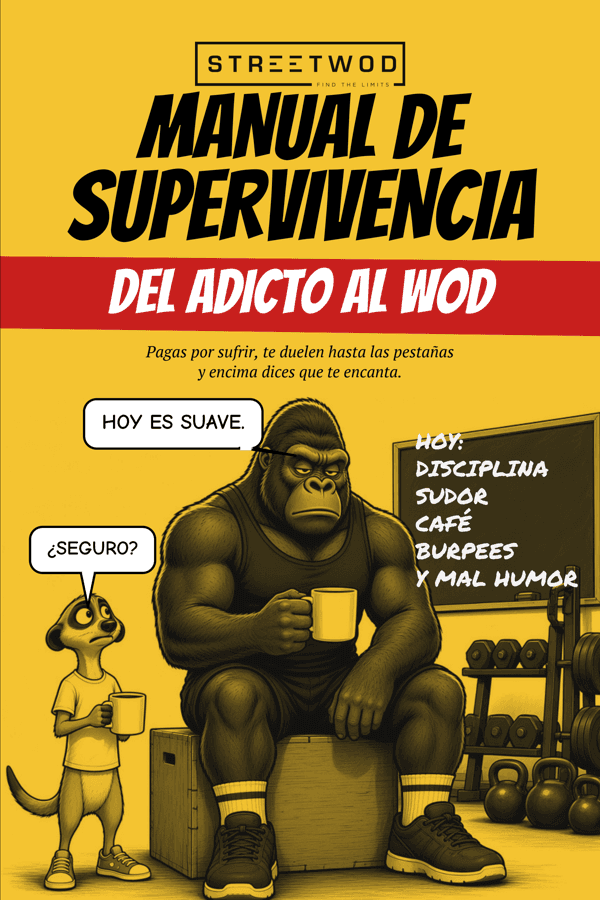
What to bring to your first HYROX: the suitcase of someone going to war
Everything you need for a hybrid workout, everything you probably have leftovers, and all those things you bought because someone on Instagram was wearing them.
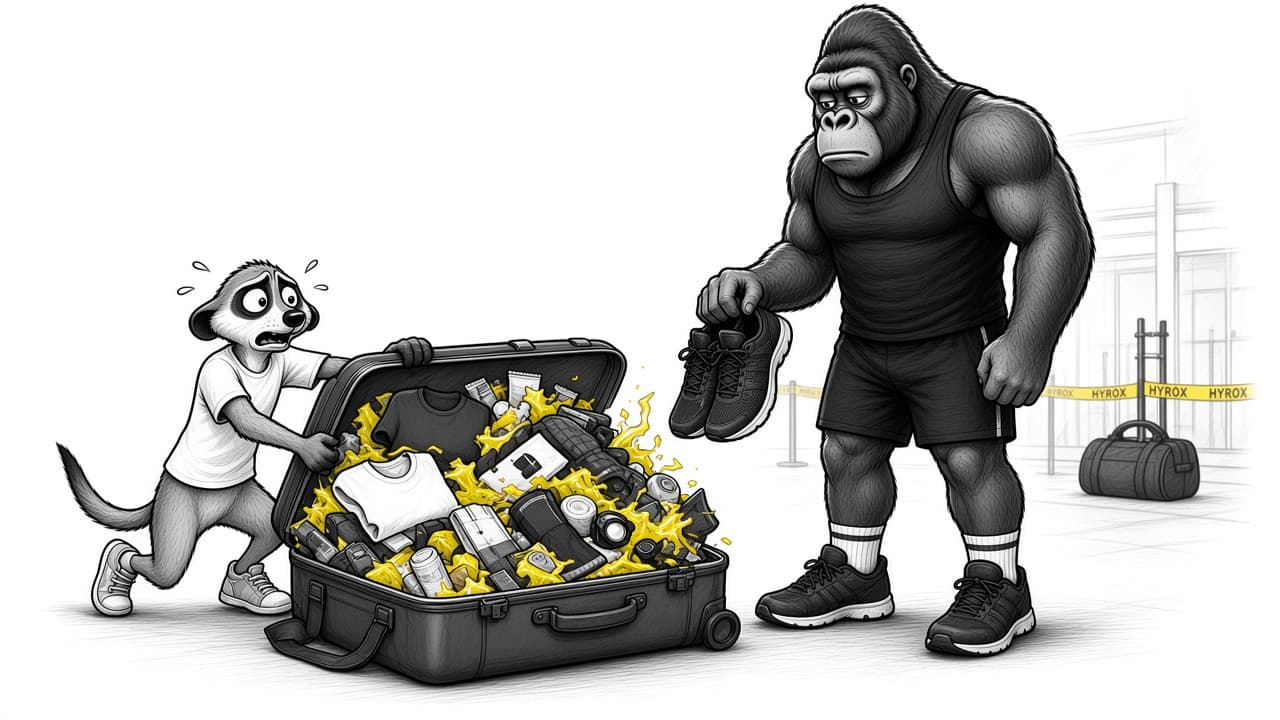
There are two types of people who go to train: those who carry a water bottle and those who need a 45-liter backpack, three compartments and road assistance.
Hybrid training has achieved something extraordinary: that to run and lift four things we need more equipment than to climb Everest.
Gorilla is wearing slippers, a towel and a clean t-shirt.
Meerkat has brought two pairs of slippers, six energy gels, a heart rate monitor, mineral salts, three types of socks and a massage roller that he still doesn't know how to use.
They are both going to do exactly the same training.
And they're both probably going to end up equally busted.
But let's see what is really worth taking to hybrid training or to your first HYROX, because there are things that help and others that only serve to make your backpack heavier than the sled.
1. Sneakers: the only material that can really save your day
Let's start with what's important.
If you are going to combine running with strength exercises, you need shoes that allow you to run comfortably and have enough stability and grip for pushing a sled, doing strides, or carrying weight.
You don't need the shoes that the world champion uses.
You need ones that work for you.
Suricato has been looking for the perfect sneakers for three weeks. He has watched 47 videos, read 19 comparisons and opened an Excel with cushioning, stability, grip and energy return columns.
Gorilla has been wearing the same ones since February.
Meerkat hasn't gone out for a run yet.
What you should look for:
- Comfort to run several kilometers.
- Good grip, especially for the Sled Push.
- Sufficient stability in functional exercises.
- A fit that does not cause chafing.
And, above all, do not wear new shoes on the day of the competition.
Your feet don't have to pay the consequences of your last minute decisions.
2. The clothes: you don't need to look like a Marvel superhero
A technical t-shirt, comfortable pants and appropriate socks.
That's all.
Really.
You don't need a competition outfit worth 250 euros to do burpees in front of a man carrying a whistle.
The important thing is that the clothing allows you to move, breathes well and does not cause chafing.
Especially in long tests.
Because a small scratch at kilometer two can become an existential crisis at kilometer seven.
Gorilla trains in a black t-shirt.
Meerkat has a t-shirt for running, another for lifting weights, another for high-intensity training, and a fourth that he only uses when he knows they are going to take photographs.
All four are practically the same.
3. Water and electrolytes: because sweating does not automatically make you an elite athlete
Hydration is important.
But there are people who have turned drinking water into an Olympic discipline.
Meerkat arrives at the gym with a two-liter bottle, three packets of electrolytes, an isotonic drink and an application that reminds him when to drink.
Gorilla turns on the faucet.
The reality is somewhere in between.
For hybrid training it is advisable to arrive well hydrated and have water available. In long, intense or very hot sessions, it may be useful to also replace electrolytes, especially sodium.
That doesn't mean you need to whip up a chemical formula before every 40-minute workout.
And drinking huge amounts of water is not better either.
What is recommended: adapt hydration to duration, temperature, sweating and individual needs.
4. Energy gels: they are not magic candies
This section deserves an explanation.
Gels mainly provide carbohydrates that can be useful during prolonged efforts.
But some athletes seem convinced that each gel contains a small portion of the spirit of an Olympic champion.
Meerkat takes one before warming up.
Another while listening to the briefing.
And he is considering a third in case the first has not yet taken effect.
Gorilla watches him while he eats a banana.
In competitions or long training, carbohydrates can help maintain performance. However, for a short session, you usually don't need to carry half a store of sports nutrition.
And there is a fundamental rule:
Never experiment with new gels on race day.
Your stomach might decide to enter a completely different competition.
5. The sports watch: knowing that you are suffering with scientific precision
Before, when you were tired, you knew it because you were tired.
Now you need a 400 euro watch that confirms that your heart rate is skyrocketing, your recovery is insufficient and your body is asking you to stop doing stupid things.
Sports watches can be useful to monitor rhythms, heart rate and progress of training.
Especially when you are preparing for a competition with several kilometers of running.
But they are not essential.
Meerkat checks his watch every thirty seconds.
Gorilla runs to the next station.
They both know perfectly well when they are suffering.
One of them has a graph to prove it.
6. Wristbands, wristbands, belts and other objects that make you look professional
Here we enter dangerous territory.
Because CrossFit has developed an extraordinary ability to turn any joint in the human body into a business opportunity.
Wristbands.
Streets.
Knee pads.
Belts.
Finger tapes.
Compression sleeves.
And some mysterious straps that Meerkat bought three months ago and still doesn't know where they go.
Some accessories are useful in certain exercises and circumstances.
But not all of them are necessary for hybrid training.
For example, grips can be useful for gymnastic bar movements, but they usually do not contribute anything in the usual HYROX stations.
And a lifting belt is no substitute for good technique.
The recommendation is simple: only carry the accessories that you actually use in your training.
If you need to consult a tutorial on putting them on, you can probably leave them at home.
7. The spare towel and shirt: the silent heroes
Finally we come to two objects that deserve to take up space in your backpack.
A towel.
And a clean shirt.
It may seem like a small thing, but after a session of running, burpees, rowing, and sledding, you'll be glad you don't have to drive for twenty minutes with your shirt stuck to your body.
Gorilla carries a towel.
Meerkat carries an ultralight technical towel with antibacterial treatment and a waterproof cover that cost more than his first gym fee.
They both dry.
Although Meerkat's has a much more impressive name.
If you are going to shower afterwards, add underwear, flip flops and hygiene products.
No need to complicate it.
8. The backpack: when carrying material becomes another WOD
Here is the real problem.
You've bought so many things for training that now you need a special backpack to carry them.
And then another bag to store the first one.
Meerkat arrives at the gym carrying a 35-liter backpack, a bag of shoes and a small toiletry bag with recovery products.
Gorilla carries a sports bag.
Meerkat takes twelve minutes to prepare.
Gorilla has already finished warming up.
A backpack with enough space, useful compartments and resistant material is more than enough.
You don't need a tactical backpack designed for military operations.
You're going to do squats and run.
Not to invade a country.
9. What you can't forget on the day of a HYROX competition
Training is one thing.
Competing is another.
When the day of your first HYROX arrives, there are certain elements that should be reviewed in advance.
The survival list:
- Identity document and required registration data.
- Entry, accreditation or access code, according to the event instructions.
- Shoes and clothing that you have already tried training.
- Spare socks.
- Water and food adapted to your needs.
- Gels, only if they are part of your strategy and you have tried them previously.
- Towel and clean clothes for later.
- Mobile charged.
- Material permitted by the competition regulations.
Always check the official rules, because not all accessories are allowed in the race and conditions can change between events.
And it arrives in time.
A long time.
You don't want to find out where the participant access is while they announce your departure over the public address system.
10. The most important material is not purchased
After all this technological deployment, comes the part that Meerkat least likes to hear.
The most important thing to perform in hybrid training does not fit in a backpack.
It's the preparation.
The constancy.
The technique.
Aerobic capacity.
The force.
And learn to manage the pace so as not to go out in the first kilometer as if a rhino were chasing you.
You can have the best sneakers on the market.
The most advanced watch.
The most expensive gels.
And a backpack with more compartments than a commercial airplane.
But if you haven't trained the transitions between races and stations, the Sled Push will put you in your place.
Without checking how much you have spent.
Conclusion: less equipment and more training
Hybrid training combines strength and endurance. And precisely for that reason, the important thing is to arrive prepared for both things.
Good shoes, comfortable clothing, adequate hydration and some basic elements usually cover the needs of many training sessions.
The rest depends on your goals, length of sessions, and personal preferences.
You don't need to buy everything.
Nor carry everything.
Nor look like a sponsored athlete to enjoy this sport.
At the end of the training, Gorilla puts away his sneakers and leaves.
Meerkat continues collecting his accessories.
-What are you doing? —Gorilla asks.
—I'm checking that I'm not missing anything.
—And how was the training?
-Evil. I ran out of air in the second round.
Gorilla looks at the backpack, filled to the top.
—Bring less things for tomorrow.
—What do I take away?
—Half of the accessories.
—And what do I put in?
-Lungs.
---
StreetWOD moral: you can carry 300 euros in equipment, but the sled will still weigh the same.
Train more. Buy less nonsense. And please pick up your discs.