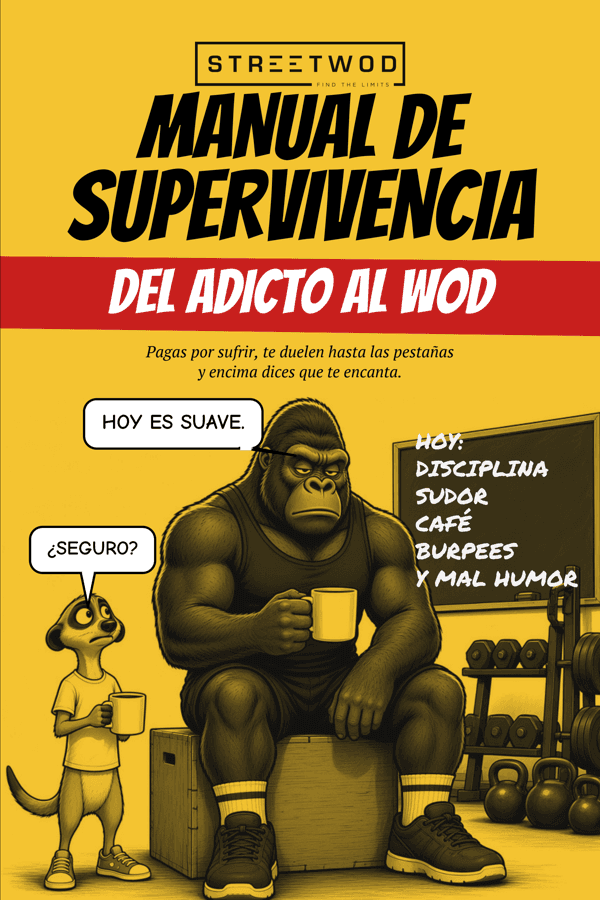
CrossFit after 40: when warming up lasts longer than training
Before you would party until six in the morning and the next day you would be as good as new. Now you sleep eight hours, get off the couch and injure yourself by yawning. Welcome to CrossFit after 40.
1. Turning 40 is not getting old. But your knees haven't received the message.
There is a moment in every athlete's life when something changes.
It doesn't exactly happen on your fortieth birthday.
A notification does not appear on the mobile.
Nor do you receive a letter from Social Security informing you that your joints have entered the limited warranty period.
Simply, one day you arrive at the gym, look at the board and discover that the warm-up worries you more than the WOD.
Before you saw:
5 ROUNDS FOR TIME
- 400m Run
- 15 Thrusters
- 10 Burpees
And you thought:
"Today I'm going to break the stopwatch."
Now you see exactly the same thing and think:
"Will there be enough time to warm up my shoulders?"
And then you wonder if you brought your knee pads.
And if you slept well.
And if the pain you have in your back is from yesterday or from 2018.
Because turning 40 doesn't mean stopping being an athlete.
It means that your body has started sending you notifications that you can't silence.
2. WODzilla discovers that warming up is an independent workout
It's seven in the afternoon.
WODzilla arrives at the gym, leaves his backpack and begins to prepare the material.
Paco Suricato appears at his side, walking with a suspicious rigidity.
—Hello, WODzilla.
-Hello good.
—What's on today?
—Squats and a fifteen-minute AMRAP.
Paco looks at the blackboard.
-Perfect. And how long does the warm-up last?
—Fifteen minutes.
—And can we do it in thirty?
-Because?
—Because I need ten minutes for my knees, ten for my back and another ten to emotionally accept what we are going to do.
WODzilla looks at him.
—Is something wrong with you?
-No. I'm fine.
"Then why do you walk like that?"
—I slept on my side.
Silence.
-AND?
—Well that. I slept on my side.
WODzilla decides not to ask any more.
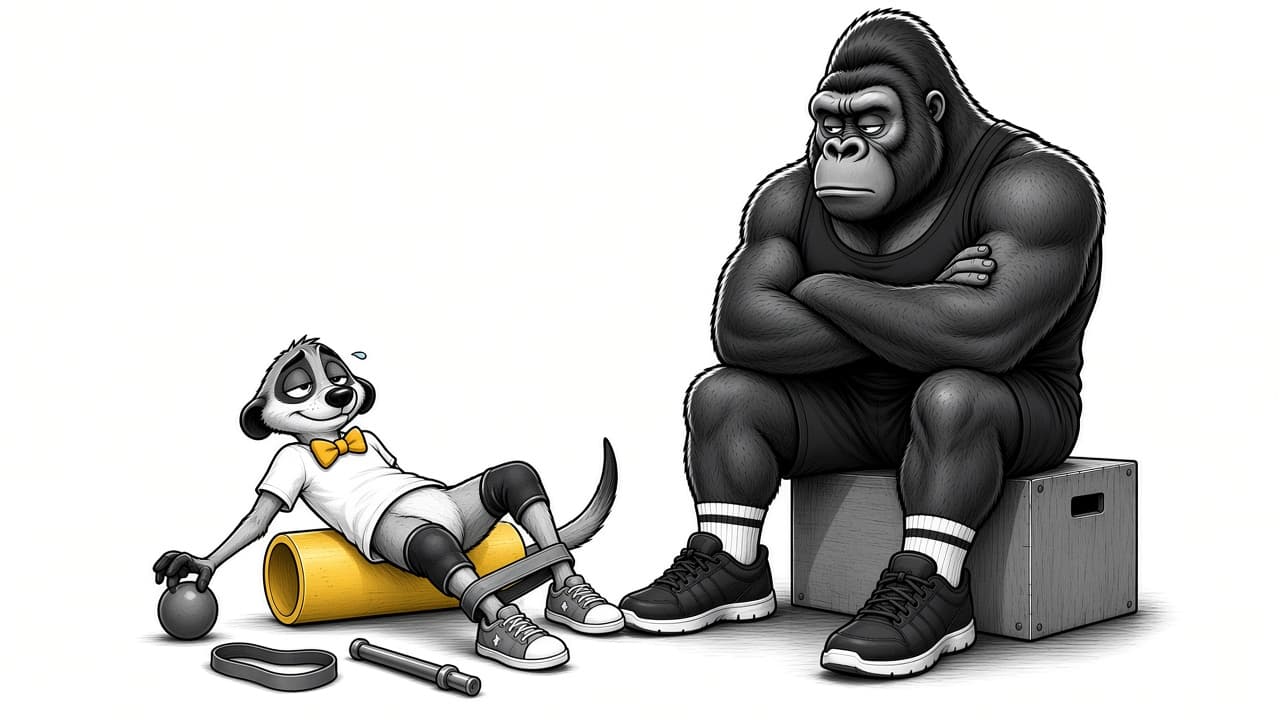
Paco takes out of his backpack an elastic band, a massage ball, a foam roller, and something that looks like a pipe repair tool.
-What's that?
—A myofascial release device.
—It looks like a wrench.
—Because you don't understand sports recovery.
The truth is that Paco is partly right.
Although you may not need to bring a full set of hardware to the gym.
Over the years, taking time to prepare your body can become more important. But warming up well doesn't mean spending half an hour doing random movements until class is over.
It means preparing the joints, progressively increasing the intensity and practicing the movements you are going to use.
3. What really changes when you train after 40
Let's get serious for a moment.
Don't worry, it will be brief.
From the age of 40, age-related physical changes may begin to be noticed, although they do not occur suddenly nor do they affect everyone equally.
Muscle mass and strength can progressively decrease if not trained.
Recovery may require more attention.
Previous injuries can affect certain movements.
And factors such as sleep, stress and work can influence performance as much as age itself.
But here comes the important thing:
Turning 40 doesn't mean you have to stop lifting heavy, running, jumping or competing.
Strength training continues to be one of the best tools to preserve muscle, functional capacity and autonomy.
And many people improve their physical condition after 40 because they begin to train with more consistency, better technique and more realistic goals.
What changes is not necessarily what you can do.
It's how you want to organize it.
Paco listens to this explanation while stretching his calves.
—So, can I continue doing CrossFit at 40?
—Sure—answers WODzilla.
—And with 50?
-Also.
—And at 60?
-Yeah.
—And at 80?
—If your health and physical condition allow it, you can continue training by adapting it.
Paco smiles.
-Perfect. So I have forty years to learn how to do double unders.
4. Warming up after 40: a ceremony that should have its own music
When you were twenty, your warm-up might consist of two arm movements and one sentence:
"I'm getting in little by little."
Now that strategy may be considerably less convincing.
A useful warm-up does not need to be eternal, but it does need to be progressive and specific.
A practical proposal of 10-15 minutes
Minutes 1-4: raise heart rate.
Cycle, row, walk briskly or jog lightly.
The idea is to start moving, not try to beat your SkiErg record.
Minutes 5-8: mobility and activation.
Work the areas you will need: ankles, hips, thoracic spine and shoulders, depending on the training.
You don't need to do seventeen different exercises.
Minutes 9-12: practice the movements.
If you need to squat, do progressive squats.
If you play clean, start with an empty bar or a light load.
If you have to run fast, do some gentle accelerations.
Minutes 13-15: approximation to intensity.
Do one or two short sets that resemble the real workout, without tiring you.
This scheme is indicative. If you have discomfort, a previous injury or need more preparation for a specific movement, it may be advisable to adapt it.
The important thing is to finish the warm-up feeling prepared.
Not sold out.
Paco finishes his routine and looks at the clock.
—WODzilla, I've been warming up for twenty-five minutes.
—And how are you?
-Perfect.
—Then the training begins.
-Impossible.
-Because?
—Now I need to recover from the warm-up.
5. The ego does not age. And that is precisely the problem.
There is a part of the human body that seems to especially resist the passage of time.
The ego.
You can be forty-five years old.
Two children.
A mortgage.
A knee that makes strange noises.
And still be convinced that you can lift exactly the same as you did when you were twenty-five.
Because your head perfectly remembers that personal brand.
Your body, on the other hand, remembers that you haven't done a heavy squat in six months.
And when both find themselves under a bar, a rather unpleasant negotiation usually ensues.
The appropriate load is not what you lifted ten years ago. It is what you can control today with good technique.
This does not mean giving up progress.
It means progressing from your current level.
Increase the loads gradually.
Respect the technique.
And stop turning each session into an exam of masculinity, youth or social prestige.
WODzilla is placing discs on the bar.
Paco approaches.
—How much are you going to lift?
—What I have programmed.
—I used to lift a lot.
-Very good.
—In 2012 I did an impressive deadlift.
-Congratulations.
"I think I could still do it."
—When was the last time you trained heavy deadlifts?
Paco looks at the ceiling.
—Does 2013 count as recently?
6. Recovery: when sleep becomes your favorite supplement
At twenty years old you could train, party, sleep four hours and show up at the gym the next day.
That didn't mean it was a good idea.
It meant that you hadn't received all the consequences yet.
After 40, recovery deserves a more important place in your planning.
Not because there is a rule that requires you to rest twice as much from a specific age.
But because your recovery capacity depends on many things: intensity, volume, sleep, diet, stress, training history and health status.
Five habits that matter more than buying another supplement
- Get enough sleep: For most adults, the general goal is to sleep between seven and nine hours per night.
- Consume enough protein: helps maintain and recover muscle, along with proper nutrition.
- Alternate efforts: not all sessions need to be maximum.
- Include easy or rest days: recovery is part of progress.
- Adjust the load when necessary: reducing intensity or volume in time can be more useful than accumulating fatigue.
And an important clarification: being over 40 does not mean that you necessarily need supplements, massages, cryotherapy or a device that costs more than your washing machine.
First review how you train, sleep and eat.
Then we talk about accessories.
Paco raises his hand.
-I have a question.
"Tell me," WODzilla replies.
—Does sleeping eight hours improve performance?
—Yes, it usually helps.
—And sleep ten?
-Depends.
—And twelve?
—Paco...
—What if I sleep straight until Monday?
7. CrossFit Masters: age does not expel you from the competition
One of the best news for those who train after 40 is that they don't have to stop competing.
In CrossFit there are Masters categories that allow you to compete within different age groups.
And you don't have to be a professional athlete to set sports goals.
You can participate in local competitions.
Prepare the Open.
Improve your brands.
Learn new skills.
Or simply trying to finish a workout that seemed impossible six months ago.
Progress does not have to be measured only in kilos lifted.
It can also mean doing your first strict pull-up.
Run five kilometers without stopping.
Improve mobility.
Or train for a whole year without giving up every time December arrives.
The best version of yourself doesn't have to be in the past.
Paco watches WODzilla.
—Hey, are there Masters categories in CrossFit?
-Yeah.
—And are they by age?
-Yeah.
—What if I join a category of older people?
—You can't choose an age you don't have.
—What if I wear a fake beard?
WODzilla continues training.
8. Injuries are not a badge of honor
There is a phrase that is heard too much in some gyms:
"If it doesn't hurt, it doesn't work."
Well no.
Muscular effort, fatigue and certain post-workout discomfort are not the same as the pain of an injury.
And learning to differentiate them is important at any age.
If a movement causes acute pain, locking, instability, or worsening symptoms, it is not a good idea to continue forcing it to prove anything.
It may be necessary to stop, modify the exercise, and consult with a healthcare professional.
It is also not mandatory to perform all CrossFit movements in their most demanding version.
You can adapt the squats.
Modify the jumps.
Reduce loads.
Change a movement that you do not tolerate well for another that allows you to work on the same objective.
Climbing a workout is not giving up. It's training intelligently.
And that also goes for someone who is twenty years old.
Paco approaches WODzilla.
—Today I'm going to do the scaled box jumps.
-Perfect.
—Instead of jumping into the gym, I'm going to walk up.
-Good.
—And instead of walking up, I had thought to go around it.
-No.
—And contemplate it from a safe distance?
—Paco.
—Okay, okay. I walk up.
9. How many days of CrossFit should you do after 40?
The answer depends on your experience, recovery, goals and the actual content of the sessions.
There is no universal number of classes suitable for everyone over 40.
Someone who has been training for fifteen years can tolerate more volume than someone who has just started.
And two sessions with a well-managed load can be more productive than five workouts always pushed to the limit.
For someone just starting out, two to three well-tailored weekly sessions can be a good starting point.
If you already have experience, you can train more days, combining intensities and ensuring sufficient recovery.
As a general reference, physical activity recommendations for adults include 150 to 300 minutes of moderate aerobic activity per week, or 75 to 150 minutes of vigorous activity, plus muscle-strengthening work at least two days per week.
It doesn't mean you have to add all that to your CrossFit classes without considering what you already do.
It means that your entire activity must be balanced.
And remember: more does not always mean better.
Paco listens carefully.
—So, two days can be enough to start?
"Yes," WODzilla answers.
—And one?
—It depends on your objectives, but you can start there.
—And half?
-Noon?
—Half class.
WODzilla walks away without responding.
10. The true advantages of training after 40
So far we have talked about warm-ups, recovery and discomfort.
But there is something that many people discover when they continue training over the years.
Experience also works in your favor.
You may no longer have the same time availability as when you were studying.
You may have family and work responsibilities and an agenda that seems designed by someone who hates you.
But you can also be more patient.
More discipline.
More ability to listen to your body.
And less need to prove something to everyone.
You learn that you don't have to win every training session.
Resting does not make you a worse athlete.
That technique matters.
And that the best program is one that you can maintain for years.
WODzilla finishes his training and starts collecting the discs.
Paco is sitting on the floor.
—Do you know what is the best thing about training after 40?
-That? —WODzilla asks.
—Maturity.
—Oh, yes?
-Yeah. Now I know perfectly well when I should listen to my body.
—And what is he telling you?
—Let's go to dinner.
11. CrossFitter Over 40 Survival Manual
If you have come this far and you are over 40 years old, we want to leave you a small manual.
You don't need to do everything perfect.
Nor become a professional athlete.
Nor prove that you are still twenty years old.
You just need to train with common sense and some regularity.
The seven rules of Streetwood:
1. Warm up for what you are going to do, not to fill time.
2. Train strength and take care of your cardiovascular capacity.
3. Progress based on your current level, not your memories.
4. Scale movements when you need to.
5. Prioritize sleep and sufficient nutrition.
6. Don't ignore pain or symptoms that may indicate an injury.
7. Enjoy the process. The goal is to continue training in ten, twenty or thirty years.
And an eighth unofficial rule:
Don't let Paco convince you that buying another pair of shoes counts as a strength session.
12. The day Paco Suricato discovered his sporting age
Class is over.
WODzilla is saving your material.
Paco remains lying face up, looking at the ceiling.
—WODzilla...
-Tell me.
—I think I'm getting older.
-Because?
—Before I could go out to party, sleep for four hours and train the next day.
—That was not highly recommended.
—Yes, but I could.
-And now?
—Yesterday I bent down to pick up the television remote and my back creaked.
WODzilla tries not to laugh.
—You have to work on mobility.
—I already do it.
-When?
—When I look for the remote control under the sofa.
WODzilla picks up his backpack.
—Tomorrow comes strength.
Paco sits up slowly.
-Legs?
-Yeah.
—Squats?
-Yeah.
—Heavy?
—Progressive.
Paco remains thoughtful.
—What if tomorrow we do something more appropriate for our age?
-Like what?
—Pétanque.
WODzilla looks at him.
—Paco, you can still train perfectly.
—Yes, but in petanque you also lift weights.
—What weights?
—The balls.
—Paco...
—And there is technique.
—Paco...
—And competition.
—Paco...
—And then you can have an aperitif!
WODzilla leaves.
Paco follows him.
—Hey, do you think there is HYROX Masters for petanque?
He didn't get a response.
But that night he was searching for it on Google.
---
Conclusion: 40 is not the end. They are another way of training.
Doing CrossFit after 40 is not about desperately trying to regain the athlete you were twenty years ago.
It's about building the athlete you want to continue being for the next twenty.
Strongly.
With mobility.
With resistance.
With head.
And, if possible, with knees that do not make noise when climbing the stairs.
It doesn't matter if you do RX, Scaled or if you need to spend a few extra minutes warming up.
It is important that you can continue training, progressing and enjoying yourself.
Because getting older is inevitable.
But stopping moving doesn't have to be.
StreetWOD Moral: At twenty years old you warm up to train. At forty you train so you can continue warming up at sixty.
And remember: You are not old to do CrossFit. Simply now your body needs you to tell it before doing something stupid.
WODzilla is already warming up. Paco Suricato is still looking for knee pads. See you at the gym.