Caffeine and training: how much, when and why your pre-workout is not a coffee
The coffee at 7:00, the pre-workout at 19:00 and the surprise of not sleeping at 23:00. Everything you need to know about caffeine at the gym.
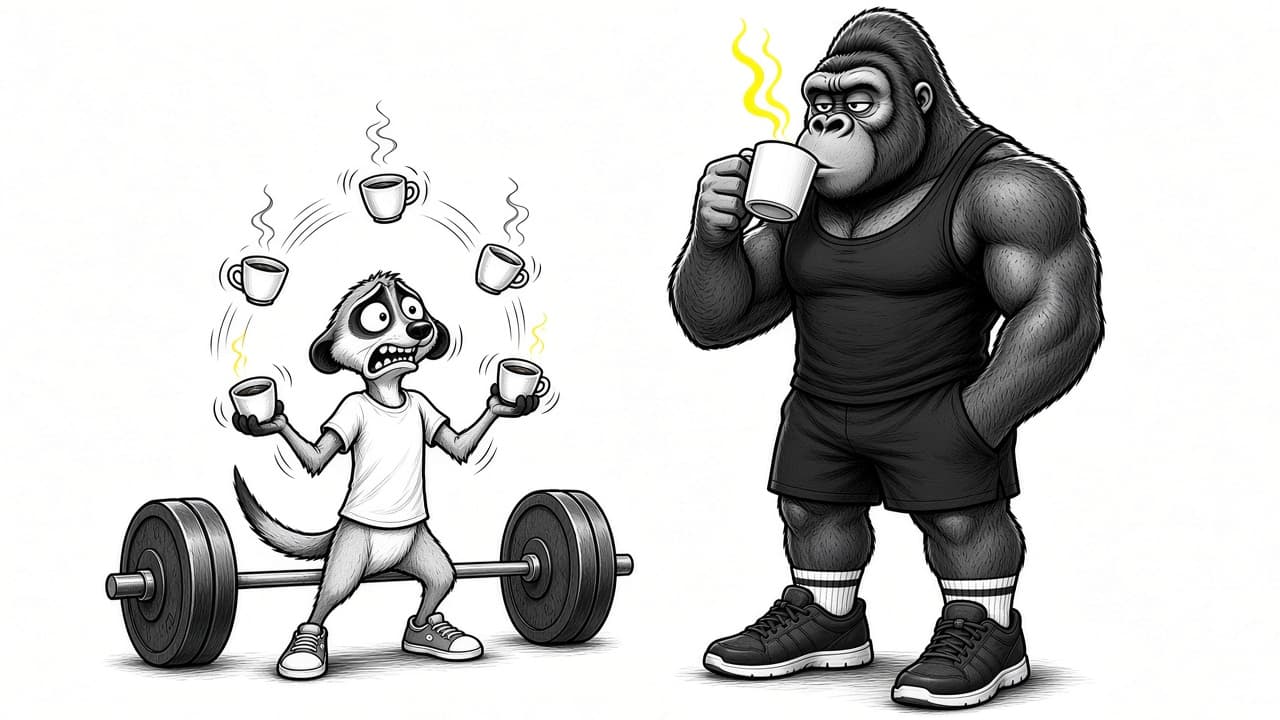
In the gym there are two types of people: those who train with coffee and those who lie. Caffeine is probably the most widely used ergogenic aid in the world, and with good reason: it works. But like almost everything that works, it has its fine print.
What caffeine does for you
Caffeine reduces the feeling of tiredness and effort. It doesn't make you a different person, but it makes minute 12 of the AMRAP seem a little less minute 12. That's why studies find performance improvements in endurance efforts, in intense series, and in strength work.
How much: the real numbers
- To perform: the International Society of Sports Nutrition (ISSN) places the usual effective dose between 3 and 6 mg per kilo of weight, about 60 minutes before training. For a 70-kilogram person, that's between 210 and 420 mg. Many people notice an effect with the lower part of the range.
- Not to overdo it: the European Food Safety Authority (EFSA) considers single doses of up to 200 mg and a total of up to 400 mg per day safe for healthy adults. In pregnancy, the limit drops to 200 mg per day. Note that the upper part of the range for yield exceeds what the EFSA considers safe in a single shot. More is not better. More often it is tremors, tachycardia and urgent visits to the bathroom in the middle of the WOD.
How much caffeine you have on you without knowing it
- An espresso: approximately between 60 and 100 mg, depending on the coffee and the coffee maker.
- A large coffee with milk: can take a lot more, especially if it is from a cafeteria.
- A can of energy drink: varies greatly depending on the brand. Look at the label.
- A little pre-workout scoop: here's the surprise. Some have 200, 300 mg or more per serving. If you have also had two coffees in the morning, do the math.
When: the problem of afternoon classes
Caffeine has a half-life of about 5 hours, although it varies greatly between people. Translation: If you take your pre-workout at 7:00 p.m., there is still a considerable amount left in your body at midnight. Then you wonder why you're staring at the ceiling at two in the morning reviewing your snatch technique. If you train in the afternoon or at night, try a lower dose, take it earlier or go without it altogether. The sleep you lose costs more performance than the caffeine gives you.
Tolerance, that silent enemy
If you drink a lot of caffeine every day, the effect is less noticeable. There are those who save caffeine for important days, like a competition, to notice it more. It is a reasonable strategy, although it is not necessary to become a monk: by not doing it every day, you already help.
Signs that you have gone too far
- Your hands shake when you put the records on the bar.
- Your heart goes to the rhythm of the double under and you haven't started yet
- You talked more in the warm-up than you did all week
- Your stomach asks you to stop. Urgently.
The StreetWOD verdict
Caffeine works, it's cheap and it's in your kitchen. Use it wisely: moderate doses, with time to spare and away from bedtime. And always try it in normal training before experiencing it on competition day. Informative content. If you are pregnant, have heart problems, anxiety problems, or take medication, consult your doctor before taking caffeine supplements.
Sources: EFSA, scientific opinion on the safety of caffeine (2015); ISSN positioning on caffeine and performance (2021).